
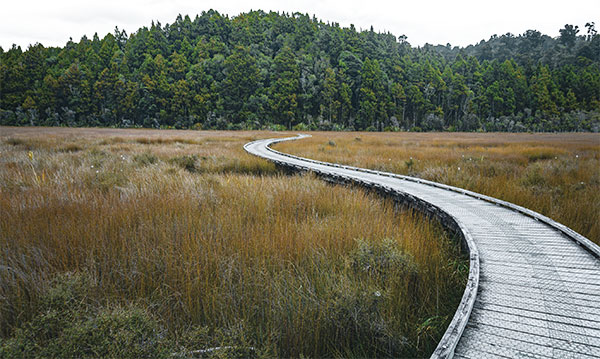
Natural assets must be recognised as core infrastructure if New Zealand is to strengthen its economy and resilience, according to a new plan released by The Aotearoa Circle.
The Natural Infrastructure Plan is the culmination of nearly a year’s work involving more than 200 contributors. It argues that wetlands, forests, dunes, waterways and soils should be treated as productive infrastructure rather than background scenery, with a direct role in supporting economic activity and national resilience.
For the construction and infrastructure sector, the approach signals a widening of the infrastructure toolkit. Nature-based solutions such as wetland creation, floodplain reconnection, dune restoration and catchment-scale water management all involve significant earthworks, hydrological engineering and landscape construction activity.
The Aotearoa Circle chief executive Vicki Watson says addressing New Zealand’s infrastructure deficit of more than $200 billion, with up to $1 trillion required over the next 30 years, alongside increasing climate exposure, demands new thinking.
“We can’t afford to rely solely on traditional ‘hard’ engineering solutions,” she says. “Natural infrastructure provides a 1+1=3 opportunity – it can reduce flood and erosion risk, improve biodiversity all while strengthening long-term economic resilience. It is a valuable tool in the infrastructure toolkit.”
David Carter, executive chair of Beca and a Guardian of The Aotearoa Circle, says the value provided by natural systems is often overlooked until major events occur.
“The immense ‘hidden value’ natural infrastructure provides tends to be taken for granted until extreme events occur,” he says. “At this point the inability of ‘hard’ infrastructure to provide the required resilience alone is evident for all to see.”
The plan aligns with the Infrastructure Commission’s call in its National Infrastructure Plan for a shift from short-term thinking to long-term value. With much future infrastructure spending expected to be absorbed by maintenance – estimated at around 60 cents of every future infrastructure dollar – the plan suggests natural systems can deliver multiple benefits while often requiring lower financial upkeep.
Six case studies included in the report, assessed and summarised by Beca, demonstrate measurable financial returns, risk reduction, job creation and wider environmental and social gains. The plan also includes an investment decision toolkit designed to help evaluate nature-based solutions alongside conventional infrastructure options.
Watson says the economic argument is increasingly clear.
“Seventy percent of our exports depend on natural resources. Severe weather events are increasing and they create economic uncertainty. Our natural systems already buffer floods, protect coastlines and support productivity but we rarely account for their value and invest appropriately.”
For construction and infrastructure decision-makers, the plan highlights growing opportunities in areas such as floodplain design, landscape engineering, erosion management and hybrid infrastructure projects where natural systems work alongside engineered assets.
The report outlines three immediate priorities for Government: formally including natural infrastructure within the definition of infrastructure under the NZ Planning Bill (2025), recognising New Zealand’s economic dependency on natural systems within the National Risk and Resilience Framework, and strengthening central and local government capability to assess and implement nature-based infrastructure solutions.
For the private sector, the plan calls for the insurance industry to raise awareness of the role natural infrastructure can play in maintaining insurability, alongside continued work on funding models and finance mechanisms capable of supporting nature-based projects at scale.
It also highlights the need to build industry capability through the sharing of case studies and practical examples demonstrating the financial and operational benefits of natural infrastructure.
Aaron Hewson, a member of The Aotearoa Circle’s Rangatahi Advisory Panel for the Agricultural and Marketing Research and Development Trust (AGMARDT) and a contributor to the plan, says the long-term opportunities are significant.
“If we can minimise harm from adverse events, like communities and farms being flooded, then just imagine what that would free us up to invest in instead. The opportunities are immense if we genuinely look after nature and recognise the value and opportunity it presents for our infrastructure, our economy, and our futures.”
Watson says awareness and capability are expected to grow as the concept gains traction across government, industry and the wider economy.
“We often believe that growth is at the expense of the environment. This plan shows we can have both.”