
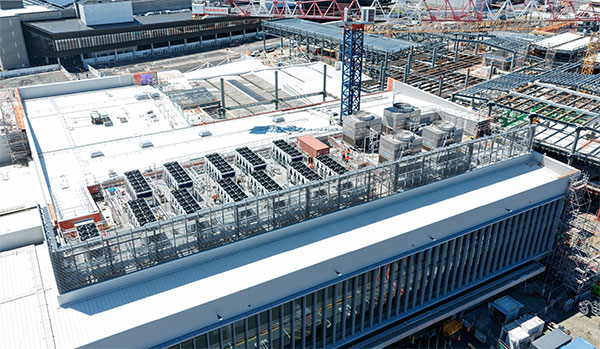
Large heat pump system replaces Auckland Airport gas plant
Auckland Airport has switched on a large-scale electric heat pump system at its international terminal, replacing one of New Zealand’s largest gas-fired air-conditioning plants and marking a significant step in the airport’s move to electrify its core infrastructure.
The $15 million project involved installing 11 industrial-scale heat pumps, each capable of delivering around 600kW of heating or cooling. Roughly the size of shipping containers, the units together provide climate control across the 141,000m² international terminal.
The system replaces plant that had heated the terminal for more than 50 years. With the new installation now operating, Auckland Airport estimates natural gas use for heating and cooling will reduce by around 40%.
Mary-Liz Tuck, chief strategic planning officer at Auckland Airport, says the project required retiring a 1970s power centre and craning the 12-tonne heat pump units up to 30 metres onto the terminal roof.
“This project marks an important step in how we’re modernising the airport’s core infrastructure while materially reducing the emissions within our control,” Tuck says.
“Electric heat pumps allow us to move away from natural gas and make meaningful progress towards our goal of cutting Scope 1 and 2 emissions by 90% by 2030, compared to a 2019 baseline.”
Installation in a live terminal
Upgrading the system required careful staging so work could proceed within a fully operational terminal handling around 30,000 travellers each day. The project involved replacing 50-year-old plant with new energy-efficient Trane units while maintaining heating and cooling across the busy terminal environment.
The installation also aligned with wider integration works at the airport, including construction of the multistorey building linking the international terminal with the future domestic jet terminal. The heat pump units sit atop this structure.
Martin Butcher, lead engineer on the project, says the technology had already been trialled in the terminal before the full installation was completed.
“That testing gave us a clear picture of how the technology performs in a working airport environment,” Butcher says.
“For the main system replacement, we transitioned the changeover in carefully planned stages, which allowed us to confirm how the system performed while keeping the terminal operating normally for travellers.”
Efficiency and system performance
Each heat pump can provide heating or cooling as required, allowing the system to operate in mixed mode, warming some areas while cooling others. Waste heat can also be recovered and reused rather than discarded, improving overall efficiency during busy travel periods.
“The building effectively acts like a thermal buffer,” Butcher says. “Temperatures shift slowly, which gives the system time to respond without creating noticeable temperature swings for people in the terminal.”
The system began operating in September 2025, with commissioning and fine-tuning expected to continue over the coming months to balance comfort levels across changing passenger volumes and confirm year-round performance.