
BRIDGING TRADITION WITH TECHNOLOGY AT UNITEC SCHOOL OF ARCHITECTURE
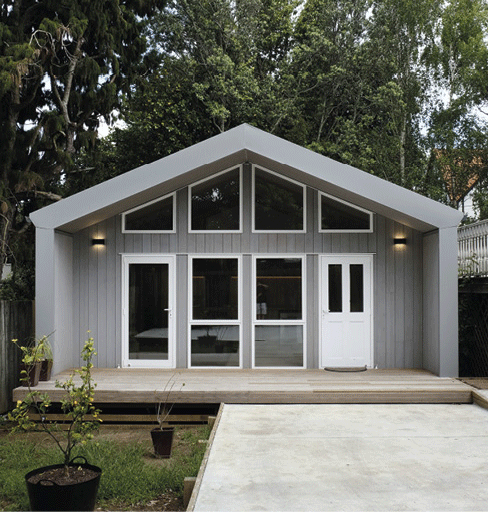
During the past eight years, the Unitec School of Architecture has researched techniques to develop prefabricated housing systems. The project’s success does not hinge primarily upon automated construction methodologies but finds a balanced approach between traditional building practices and technological innovation.
“The main aim of the work is to to demonstrate how small-to-medium enterprises (SMEs) in New Zealand’s construction sector can adopt prefabrication,” says Dr Yusef Patel, co-owner of the project with Semisi Potauaine. The research leverages commonly found skills and abilities to investigate systems for construction that create efficient approaches to building that can additionally employ community labour to give greater agency to those wanting, or needing, to build.
A collaborative effort began in 2014 involving students, faculty, and industry partners highlighted the importance of applying theoretical designs practically through full-scale prototypes. By 2016, Unitec students had created a 10sqm prototype using laminated veneer lumber (LVL) and modular plywood, enhancing labour efficiency and reducing waste with each iteration.
In 2017, students worked with Prefab NZ (named Offsite NZ in 2021), Xpo exhibitions, Carter Holt Harvey Woodproducts and Proclima NZ to produce a prototype of BuildNZ and Designex expo. The work sought to develop the 2016 design by incorporating construction technologies such as blow-in insulation and modular wiring systems.
These developments led to the construction of a 65sqm two-bedroom home, overcoming various challenges in project management, funding, and assembly. The project demonstrated the potential of prefabrication, involving all necessary subcontractors to meet building codes.
Currently, the school is advancing to a 120sqm two-story house, further integrating innovative practices. This ongoing work supports the industry by merging traditional methods with new technologies.
“Unitec’s research provides a practical blueprint for SMEs to engage in prefabrication without costly technology. The project’s success hinges on collaborative efforts, adaptable techniques, and integrating new technologies, showcasing the transformative potential of prefabrication in construction,” says Patel.